Origin vs. Metis ESG: Supplier Risk Due Diligence vs. The Audit-Ready Enterprise Ledger
Comparing Metis ESG's AI supplier risk due diligence against Origin's audit-ready operational ESG ledger. Discover how CFOs, sustainability leaders, and industrial manufacturers choose between top-down vendor screening and bottom-up statutory compliance.

System of Record
Origin ESG Ledger

Comparison Target
Metis ESG

The Two Fronts of Enterprise ESG: Supplier Due Diligence vs. Internal System of Record
As global ESG compliance shifts from voluntary public relations into statutory financial reporting—driven by IFRS S1/S2, EU CSRD/CBAM, SECP Pakistan, and GCC Exchange mandates—enterprise leaders face two distinct operational challenges:
- Third-Party Supply Chain Due Diligence: Evaluating whether external suppliers, vendors, and portfolio companies maintain proper ESG policies and counterparty risk controls.
- First-Party Operational Accounting & Audit Defense: Recording, calculating, and proving an enterprise's own physical resource consumption (Scope 1, Scope 2, Scope 3 Cat 5 waste, water, and labor governance) across multiple industrial facilities with mathematical proof for statutory financial auditors.
Both Origin and Metis ESG are AI-native platforms operating in this landscape, with prominent footprints in the Middle East and international markets. However, their core architectures, data models, and target users address fundamentally different layers of the compliance stack.
This guide provides a technical comparison of Origin and Metis ESG to help CFOs, Chief Sustainability Officers, and Risk Committees evaluate the right solution for their operational and regulatory requirements.
High-Level Architectural Comparison
| Dimension | Metis ESG | Origin |
|---|---|---|
| Core Value Proposition | Top-down supplier risk screening & due diligence without questionnaires | Bottom-up operational ESG accounting system of record & immutable audit ledger |
| Primary Audience | Procurement heads, supply chain managers, private equity & portfolio analysts | CFOs, VP Sustainability, Plant Operations leads, and Statutory External Auditors |
| Data Ingestion Model | Qualitative vendor policies, supplier disclosures, certificates, and macro risk models | Direct operational telemetry, utility bills, weighbridge slips, SCADA, and fuel logs via computer vision |
| Calculation Engine | Risk scoring, maturity benchmarks, and supplier remediation recommendations | Deterministic mathematical formulas (Activity × Emission Factor) with zero estimation black-boxes |
| Internal Governance | User role access & supplier feedback loops | Strict Maker/Checker dual-control segregation of duties (ISAE 3000 / SOX compliant) |
| Audit Traceability | Document-level qualitative extraction citations | Cryptographically sealed SHA-256 block ledger linking final disclosure line back to source meter voucher |
| Statutory Frameworks | CSDDD, general ESG risk benchmarks, portfolio metrics | IFRS S1/S2, GRI Standards, EU CSRD/ESRS, SECP Pakistan, Tadawul & ADX |
Deep Dive 1: Top-Down Supplier Screening vs. Bottom-Up Operational Asset Ingestion
The Metis ESG Approach: AI Document Due Diligence for Supply Chains
Metis ESG (headquartered in Dubai AI Campus, DIFC) was designed to solve a painful procurement bottleneck: supplier questionnaire fatigue. Traditional vendor due diligence platforms (such as EcoVadis or manual Excel surveys) rely on external suppliers filling out hundreds of subjective survey questions.
Metis replaces this with an AI-driven document evaluator:
- Macro Inherent Risk Mapping: Evaluates supplier risk profiles across 200+ countries and sectors in under 60 seconds (Metis Map).
- Automated Policy Parsing: Evaluates supplier-uploaded PDF policies (e.g., Code of Conduct, Human Rights Statements, ISO Certifications) in under two hours without manual forms (Metis Evaluate).
- Remediation Roadmaps: Gives suppliers guided action plans to improve their maturity scores (Metis Sustain).
This makes Metis ESG an effective tool for corporate procurement teams and investment analysts looking to identify high-risk counterparties across broad third-party vendor networks.
The Origin Approach: High-Frequency Physical Evidence & Computer Vision
While Metis evaluates third-party vendor policies from the top down, Origin is the operational operating system for the enterprise's own facilities from the bottom up.
Industrial manufacturers, logistics conglomerates, and multi-facility enterprises cannot satisfy statutory carbon accounting or financial audits with policy summaries. They require high-frequency physical consumption evidence:
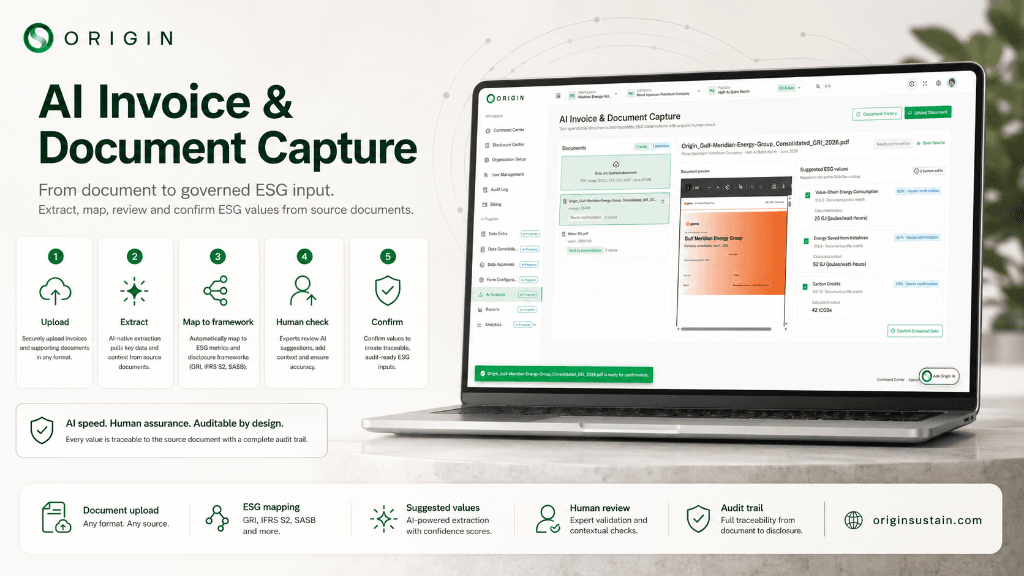
- Computer Vision Document Extraction: Ingests raw utility electricity bills (e.g., DEWA, SEC, K-Electric), bulk diesel fuel delivery slips (e.g., Saudi Aramco, ADNOC), and industrial scale tickets with exact optical bounding boxes.
- Deterministic Mathematical Translation: Binds every physical unit (kWh, Liters, Metric Tonnes) directly to validated regional emission factors without black-box estimations or generative hallucinations.
- Multi-Facility Topology: Provides plant managers and corporate sustainability teams real-time anomaly telemetry across distributed operating assets in the UAE, Saudi Arabia, Pakistan, and Asia.
Deep Dive 2: Qualitative Risk Scoring vs. The Maker/Checker Immutable Ledger
The most critical architectural distinction between Metis ESG and Origin lies in governance and audit defensibility.
Operational Workflows Compared
Metis ESG Due Diligence Flow:
- Vendor Upload: External supplier uploads policy PDF or certificate to vendor portal.
- AI Extraction: LLM extracts policy commitments, human rights statements, and maturity scores.
- Scorecard Generation: Procurement team receives vendor risk benchmark and remediation guidance. Origin Financial-Grade Audit Ledger Flow:
- Raw Evidence Ingestion: Computer vision extracts raw physical activity from utility invoices or fuel delivery vouchers with bounding box precision.
- Maker Step: Facility operations engineer validates physical parameters and binds source PDF evidence.
- Automated Anomaly Detection: System scans historical baselines; unexpected variance triggers an automatic discrepancy alert.
- Checker Step: Sustainability / Financial Controller inspects variance, enters justification footnote, and performs dual sign-off.
- Cryptographic Sealing: Record is committed with an immutable SHA-256 block hash for ISAE 3000 financial assurance.
- Statutory Disclosure: Verified metric compiles directly into board packs and Big-4 audit packages.
Why Financial Auditors Require Maker/Checker Dual Control
Under statutory frameworks like IFRS S2, CSRD, and ISAE 3000 assurance, ESG metrics are scrutinized with the same rigor as revenue and EBITDA. Internal audit committees cannot publish numbers derived from unverified single-user entries or automated black-box summaries.
Origin enforces the Four-Eyes Principle (Maker/Checker dual-control):
- The Maker (Facility Engineer): Ingests raw invoices or SCADA metrics and uploads physical proof files.
- Automated Anomaly Radar: If diesel volume spikes +28.4% above the 12-month plant baseline, Origin triggers an automated discrepancy flag requiring justification.
- The Checker (Sustainability / Financial Controller): Must review the variance, add audit justification footnotes, and formally sign off before the record commits to the statutory ledger.
- Cryptographic Sealing: Every finalized disclosure line receives an immutable SHA-256 hash, ensuring that retroactive tampering or accidental formula overwrites are mathematically impossible.
Deep Dive 3: The "One Data Spine" for Multi-Framework Compliance
Enterprise sustainability teams often spend hundreds of hours manually reformatting the same operational data for different domestic and international reporting standards.
Origin solves this with "One Data Spine" Architecture:
- Data is collected once at the facility level (e.g., 18,500 L of generator fuel in Dammam).
- Origin automatically translates that single verified event into statutory disclosure tables across:
- IFRS S2: Paragraph 29(a) Gross Scope 1 Stationary Combustion.
- GRI Standards: GRI 305-1 Direct Emissions & GRI 302-1 Energy.
- EU CSRD / ESRS: ESRS E1-6 Gross Scope 1 with CBAM unit conversion.
- SECP Pakistan ESG Guidelines: Environmental Pillar § E1.1.
- GCC Exchanges (Tadawul & ADX): Unified ESG Metric E1.1.
While Metis provides high-level supplier risk indicators, Origin produces the exact line-item disclosure tables required for statutory filings and Big-4 assurance sign-off.
When to Choose Metis ESG vs. When to Choose Origin
Choose Metis ESG if:
- Your primary pain point is supplier questionnaire response rates: You manage hundreds of external vendors and want to assess their general ESG policy existence without sending manual Excel forms.
- You are a Private Equity or Investment Fund: You need rapid macro ESG due diligence and maturity scoring across portfolio acquisitions.
- You focus primarily on supplier risk screening: You do not manage internal factory operations, physical meter telemetry, or direct Scope 1 & 2 utility accounting.
Choose Origin if:
- You are an industrial manufacturer or multi-facility enterprise: You operate plants, warehouses, or real estate assets across the GCC, UAE, Saudi Arabia, Pakistan, or Asia and need to track physical energy, water, fuel, and waste.
- You are preparing for statutory financial audit (IFRS S1/S2, CSRD, SECP): You require an immutable, Maker/Checker dual-control system of record that Big-4 auditors can verify down to source invoice vouchers.
- You want to replace fragile spreadsheets with automated AI ingestion: You need to eliminate human formula errors, broken VLOOKUPs, and lost PDF vouchers across your operating entities.
- You need comprehensive E, S, and G governance: You require complete tracking of Scope 1/2/3 emissions, water management, workforce safety, board diversity, and anti-corruption registries in a single command center.
How Origin and Metis ESG Complement Each Other
For large enterprise groups and supply chain ecosystems, Origin and Metis ESG are not mutually exclusive—they represent complementary tiers of the sustainability maturity curve:
- External Due Diligence: The enterprise procurement division uses Metis ESG to screen tier-1 suppliers and evaluate third-party vendor policy maturity.
- Internal Operating Ledger: The enterprise's manufacturing divisions, CFO, and ESG committees use Origin as the definitive internal system of record to ingest raw facility evidence, enforce Maker/Checker controls, and generate audit-defensible disclosures.
In fact, an enterprise operating on Origin produces the exact structured, mathematically verified evidence that due diligence evaluators and rating systems trust most.
Summary: Choosing the Right Foundation
| Evaluation Metric | Metis ESG | Origin |
|---|---|---|
| Category | Supplier Risk Intelligence | AI-Native Enterprise ESG Ledger |
| Deployment Model | Cloud Vendor Portal | Enterprise Operating System & Facility Hub |
| Data Verifiability | Qualitative Document Matching | Mathematical Bounding Box + Cryptographic Hash |
| Audit Readiness | Benchmark Scorecard | Financial-Grade Statutory Assurance (ISAE 3000) |
| Regional Customization | Global Country/Sector Risk | Localized GCC & Asian Grid Factors, Multi-Entity Structures |
To discover how Origin transforms raw facility evidence into an audit-defensible ESG ledger, request an interactive enterprise demo today.
Origin ESG Infrastructure
Move from scattered spreadsheets to audit-ready compliance.
See how Origin structures facility-level ESG data, automates utility invoice ingestion, and creates verifiable evidence chains for CFOs and auditors.