Origin vs. Persefoni: Why Industrial CFOs Need an Operational Evidence Ledger Over Financed Emissions Calculators
A technical teardown comparing Persefoni's top-down, spend-centric carbon accounting against Origin's bottom-up multi-facility immutable ledger, Maker/Checker governance, and raw SCADA/utility evidence ingestion for industrial manufacturers.

System of Record
Origin ESG Ledger

Comparison Target
Persefoni

The Architectural Divide: Financial Proxies vs. Physical Reality
As corporate sustainability reporting aligns with statutory financial audit standards—governed by IFRS S1 and S2 (ISSB), CSRD, and ISAE 3000 assurance mandates—Chief Financial Officers (CFOs), Heads of Internal Audit, and Chief Risk Officers face a critical infrastructure decision.
The enterprise carbon accounting software landscape is fundamentally divided between top-down financial estimation tools and bottom-up operational systems of record.
While Persefoni engineered its carbon accounting framework around the Partnership for Carbon Accounting Financials (PCAF) for asset managers and corporate portfolios, industrial manufacturers in the GCC and Asia require ground-truth physics. Spend-based multipliers introduce massive variances that fail statutory assurance.

Head-to-Head Architectural Comparison
| Architectural Dimension | Persefoni | Origin ESG Ledger |
|---|---|---|
| Core Data Origin | Top-down ERP general ledger spend and procurement lines | Bottom-up raw physical activity (meters, fuel logs, weighbridges) |
| Internal Control Framework | Centralized analyst permissions | Strict multi-tier Maker/Checker segregation of duties |
| Evidence Traceability | Document repository linked to estimates | Cryptographic hashing linked directly to source PDFs and sensors |
| Discrepancy Checking | Static variance reports | Automated dynamic threshold and thermal efficiency anomaly checks |
| Facility Hierarchy | Corporate parent roll-up | Multi-tenant plant digital twins with localized grid and fuel factors |
| Audit Defensibility | Relational mutable database logs | Tamper-evident immutable ledger with point-in-time state reconstruction |
Bottom-Up Telemetry vs. Spend-Based Modeling
In heavy manufacturing—such as cement kilns, electric arc furnaces (EAF), chemical cracking, and textile finishing—calculating emissions using financial spend multipliers introduces severe errors due to commodity price fluctuations and captive co-generation. Origin ingests ground-truth physical telemetry directly:
-
Continuous Emission Monitoring Systems (CEMS): Direct flue gas telemetry and oxygen-corrected concentrations.
-
Raw Energy Billing Ingestion: Line-item OCR extraction of gross calorific values (GCV), power factors, and peak/off-peak tariff bands.
-
Mass-Balance Feedstock Tracking: Weighbridge records for clinker, scrap charge, and direct reduced iron (DRI).
Enforcing SOX-Grade Segregation of Duties
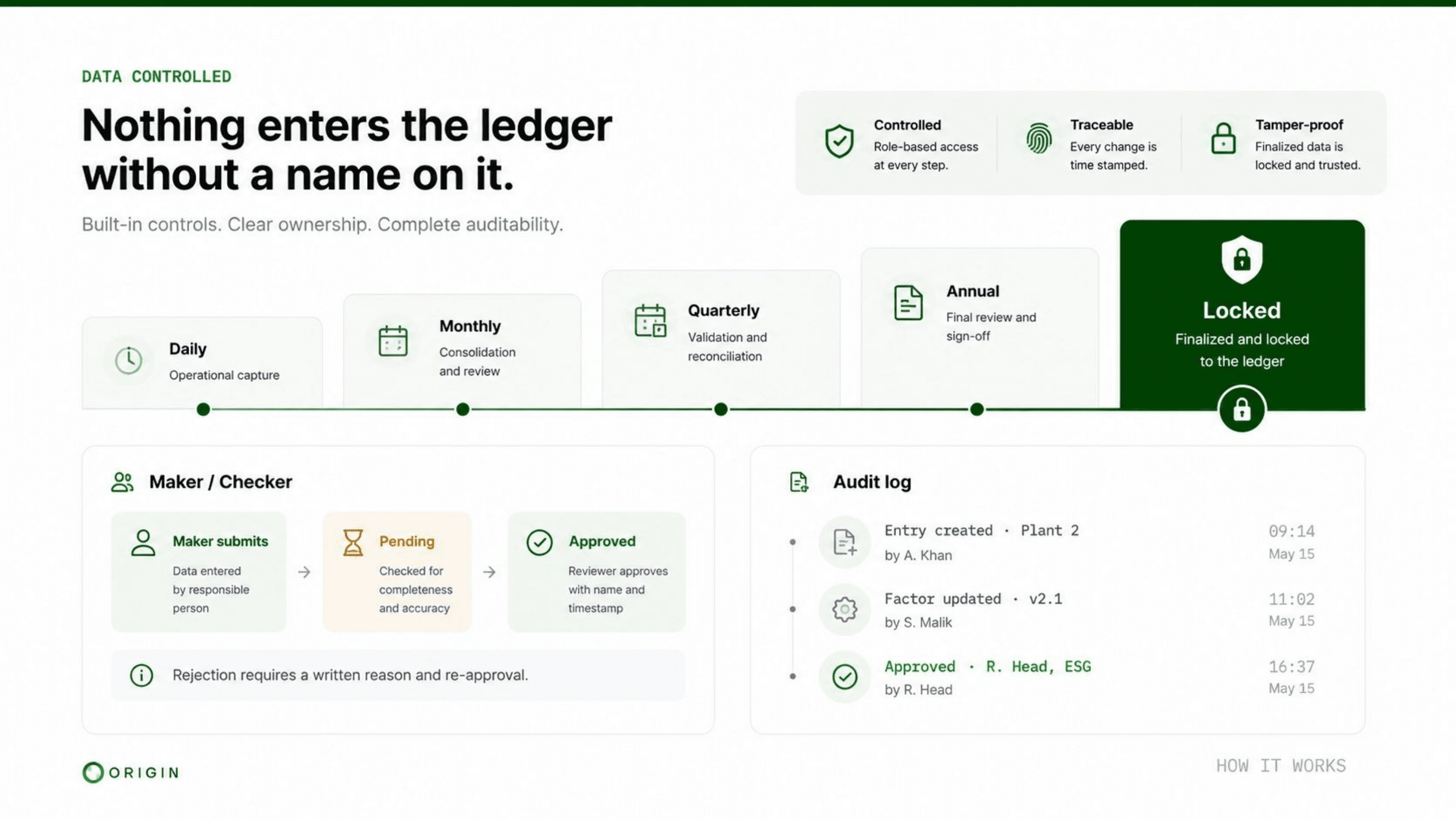
Under Sarbanes-Oxley (SOX) and international internal control frameworks, non-financial statements require the same strict Segregation of Duties (SoD) as the financial general ledger. Origin eliminates unauthorized manual overrides through Maker/Checker workflows:
-
Maker Submission: A plant engineer logs fuel consumption with the primary invoice attached.
-
Automated Anomaly Gate: The system tests the entry against historical operating envelopes and standard deviations.
-
Checker Approval: An authorized controller executes a digitally signed review before the record is posted to the immutable ledger.
Institutional Governance & Board Audit Readiness
While Persefoni remains an established choice for investment portfolios and corporate PCAF financed emissions, Origin provides the industrial-grade, operational system of record required to survive rigorous statutory assurance.
Origin ESG Infrastructure
Move from scattered spreadsheets to audit-ready compliance.
See how Origin structures facility-level ESG data, automates utility invoice ingestion, and creates verifiable evidence chains for CFOs and auditors.